Multiple Choice
Identify the
letter of the choice that best completes the statement or answers the question.
|
|
|
1.
|
If y varies directly with x, and the y=15 when x=24,
find x when y= 25.
|
|
|
2.
|
If y is inversely proportional to x, and y=6 when x=5,
find x when y=12.
|
|
|
3.
|
If z varies jointly as x and the square root of y, and
z=6 when x=3 and y=16, find z when x=7 and y=4.
|
|
|
4.
|
The electrical resistance of a wire varies directly as
its length and inversely as the square of its diameter. One hundred meters of wire with a diamter of
6 mm has a resistance of 12 ohms. Eighty meters of a second wire of the same material has a
resistance of 15 ohms. Find the diameter of the second wire. a. | 345.6 | c. | 23.04 | b. | 4.8 | d. | 4.32 | | | | |
|
|
|
5.
|
Divide  by
by 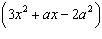
|
|
|
6.
|
Use Synthetic Divsion to divide  by by  a. | | c. |  Remainder 34
 | b. | | d. |  Remainder 54 Remainder 54 | | | | |
|
|
|
7.
|
Use Synthetic Division to divide 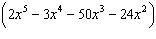 by by  a. | | c. | | b. | | d. |  Remainder 5 Remainder 5 | | | | |
|
|
|
8.
|
|
|
|
9.
|
Solve  , if , if  is a root for the other two roots.
|
|
|
10.
|
Find the cubic equation with the integer coefficients
that has 2 and  as roots.
|
|
|
11.
|
Find the remaining root of a cubic polynomial if 5 and
 are two of the roots. are two of the roots.
|
|
|
12.
|
Find the
remaining root of a cubic polynomial if  and
and  are two of the roots are two of the roots
|
|
|
13.
|
How many roots does the following equation
have?
|
|
|
14.
|
Use Descartes Rule of Signs to determine how many
Positive Real Roots does the following Polynomial have?
a. | 1 | c. | 2 or
0 | b. | 3 or
1 | d. | 5, 3, or
1 | | | | |
|
|
|
15.
|
Use Descartes Rule of Signs to determine how many
Negative Real Roots does the following Polynomial have?
|
|
|
16.
|
Use Descartes
Rule of Signs to determine how many Complex Roots does the following Polynomial
have?
a. | 0 | c. | 0, or 2, or
4 | b. | 0 or 2
| d. | 3 or
1 | | | | |
|
|
|
17.
|
List all of the possible rational roots of the
polynomial:
a. | | c. | | b. |  , ,
| d. | | | | | |
|
|
|
18.
|
List all of the actual rational roots of the
polynomial:
|
|
|
19.
|
Use synthetic division to find the value of P(2) for
the polynomial: 
|
|
|
20.
|
Alg2_8_5_pg.375 #1-8
Use synthetic division to find the value of P(4) for
the polynomial: 
|